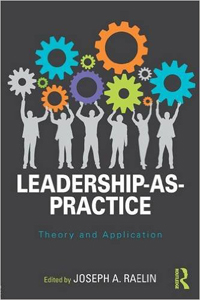
 Leadership-as-Practice: Theory and Application
Interview with Joseph A. Raelin
Purchase

Joseph Raelin is Asa Knowles Chair of Practice-Oriented Education and Professor of Management and Organizational Development at Northeastern University. His work is currently focused in two areas: work-based learning and the development of a new paradigm for leadership he calls “leaderful practice.” In addition to his work as an organizational consultant, Raelin serves on several boards and as an editor of several journals and book series. The recipient of several prestigious research awards, he is the author of numerous papers, books, and conference presentations.

Howard Youngs is a Senior Lecturer in educational leadership at Auckland University of
Technology (AUT) in New Zealand. His research focuses on shared and distributed forms of
leadership and how these constructs can assist our understanding of practice labeled as
leadership. For further reading please refer to his referenced work in this article. Howard has presented on Understanding Shared Leadership-as-Practice
Through the Application of Social Network Analysis Tools at the 2013 Oceania ILA
conference in Auckland and more recently at the 2015 ILA global conference in Barcelona.
Howard Youngs: Joe, thank you for making yourself
available to talk about leadership-as-practice and your new
edited book. But first, a little bit about yourself. What have
been some significant points on your journey leading up
to the publication of Leadership-as-Practice: Theory and
Application?
Joseph Raelin: I also subscribe to the humanistic premise that anyone
affected by a decision should be involved in that decision.
Some readers may recall my earlier book, The Clash of
Cultures: Managers Managing Professionals, where I tried
to re-establish a mutual, respectful relationship between
professionals and those who are assigned to manage them. I
also spent some time on collective learning, which requires
viewing knowledge as fluid and impermanent rather
than fixed. Rather than seeing learning as hierarchically
provided by those who know to those who don’t, I saw
learning as arising from a contestation among engaged
actors. In the leadership domain, I called for creating
leaderful organizations
in which everyone could
be involved in leadership
not just sequentially
but concurrently and
collectively; in other
words, at the same time
and all together.
When it comes to leadership-as-practice, I am challenging
some traditional views of leadership that have relied
on the grandeur of particular traits and behaviors of
gifted individuals who are accorded power over those
called “followers,” who are told to take their place in
line. Historically, that has been the starting point for any
discussion of leadership. However, I am proposing that we
view leadership as collective action emerging from mutual
discursive, sometimes recurrent, and sometimes evolving
patterns in the moment and over time among those engaged
in the practice.
HOWARD: Thank you, Joe. There are several significant
points in there. At the end of your response, you came to a
point of making sense of what leadership is and what it is not
for you. How has that been shaped across your life?
JOE: I seek to release leadership from its role-driven,
romantically-based influence relationship. We do not have
to be dependent on particular individuals to mobilize action
and make decisions for others. We can have leadership without pre-establishing the occupants of the leadership
roles. I see leadership as a process of co-creation. The
effort is intrinsically collective. The parties to the practice
engage in semiotic, often dialogical, exchange. When the
participants are genuinely committed to
one another, they display an interest in
listening to one another, in reflecting upon
new perspectives, and in entertaining the
prospect of changing direction based on
what they learn. When you don’t require
pre-specified outcomes, practice can
actually precede agency and focus on
a process inclusive of the participants’
own communal shared and exploratory
discourses. I like to say that to find
leadership, we must look to the practice
within which it is occurring.
HOWARD: The leadership-as-practice,
L-A-P, movement appears to be very timely
for the leadership field. Why do you think
this is? Why this book right now?
JOE: I think the book is indeed timely because we are at a
moment in leadership research when both researchers and
practitioners are thirsty for new models of leadership that
are more practical, far-reaching, and reflective to help us
— in an increasingly collaborative world — move beyond
the standard individualistic approach that retains a classic
directive mentality.
Fortunately, there are many other allied traditions that have
joined us, even preceded us, in this critical movement. For
example, there are the shared and distributed models that
speak to leadership as a mutual and plural activity although,
compared to L-A-P, these approaches tend to keep the
standard leader-follower roles intact while attempting to
distribute power more fairly. Of course, in this case, Howard,
I am mindful of your own work critiquing distributed
leadership, in which you question whether or not this
distribution is as fair as might be thought.
There is also the relational leadership approach which is
probably our closest cousin, the difference being that we
incorporate materiality as a significant part in the process
of production not simply because practices always imply
the use of tools and objects, but because
the latter truly make a difference in the
course of action. In addition, the relational
approach tends to be largely what is called
entitative, whereas the L-A-P model is
predominantly process-oriented. Entities
are stable, controllable things that stand
alone or are in subject-to-subject or subjectto-object
relationships. In our process
approach, humans and their socio-material
elements co-constitute as an unfolding set
of fluid emergent practices.
HOWARD: So for the leadership
developers, leadership educators, and
leadership researchers who are members of
ILA, why should the L-A-P movement be
of particular interest to each of them?
JOE: I think our movement is incredibly important to ILA
practitioners and researchers alike. Perhaps most critically,
I fear that our over-reliance on an individual heroic model
of leadership will only continue to dampen the energy and
creativity of people in our organizations and communities.
I’m not sure we know, furthermore, whether leadership
has a distinct impact compared to structuring or reward
systems. And, if it were to have an impact, what would be
the ultimate effect on those who would be called followers?
Are they to remain in a followership state? If so, for how
long? If they continue as followers, what does it say about
their own prospective agency, or are they in a permanent
state of dependency or helplessness? If we are uncertain
or dissatisfied with leadership, the L-A-P model allows the
parties committed to a practice to enter an authentic dialogue
to reproduce or transform the very practice in which they are
engaged. And, in so doing, they are creating leadership.
HOWARD: Thanks, Joe. As you were saying that, it brought
back some memories from my own personal experience.
When I was a school leader, a deputy principal, a number
of us would attend conferences and I remember listening to
speakers and if that speaker or researcher or academic did
not understand the complexity of our day-to-day practice, we
lost interest and were turned off. That is something that has
continued to be important over the years and now as I engage
in research and in postgraduate teaching. The whole L-A-P
movement really resonates, particularly for those of us who
have come from a very strong practitioner background.
When I started reading your book, I noted straightaway how
it was organized into four clear paths: background, embodied
nature, social interactions, and application. Can you provide
an overview of how these parts link together and yet also
provide some distinctiveness so the multiple perspectives
emerging within L-A-P are captured?
JOE: Sure. Before I do that, I just want to make one
comment about your experience as a school administrator.
Certainly in the United States, and maybe it is the case in
Australasia as well, we have a problem with engagement —
I suppose I should say disengagement — in the workforce.
We need to know why it is that employees, the so-called
followers, seem to be turned off and why they become
especially turned off when they’re promised the opportunity
to participate in an organization in some kind of coleadership
capacity. The promise is not always followed by
legitimate involvement. The L-A-P movement is strategically
designed to address this gap between this espoused theory of
engagement and actual practice.
HOWARD: Yes, I agree.
JOE: So with that foundation in mind, we carefully focused
on particular themes to give a well-rounded view of the
L-A-P movement. As you mentioned, there are four parts:
background, embodied nature, social interactions, and
application. In the background section, the focus is on the
comparative elements as well as some of the philosophical
and ideological traditions that underlie L-A-P. In the
embodied nature section, I suggest that it is not cognition
in its isolated form located within the mind of a prime
instigator — call him or her the leader — that mobilizes
leadership. Rather, leadership occurs from an interaction
with the environment through both individual and collective
sensorimotor processing. This section also covers questions
of identity, materiality, and interpretation.
In the social interaction part, the authors are careful to
distinguish the nature of the interaction which occurs in
leadership practice as an activity which is more than just an
exchange between individuals. It is often an in-the-moment
intra-action — not inter, but intra-action — out of which a
dynamic unfolding may emerge in some form of leadership
agency. The focus here is on the conversational dynamics
that reorient the flow of practice. In the last part, we take
up three important applications of the L-A-P movement,
namely questions of diversity, methodology, and leadership
development.
HOWARD: In each of the four sections of the book, the
authors refer to other chapters in their section and sometimes
to chapters in other parts of the book. As the editor of
the book, how did you manage it so that this eclectic
connectedness could emerge as someone reads through the
whole book?
JOE: Thanks for noticing this, Howard. At the outset
of the project we endeavored to practice what we were
preaching and vowed to collaborate as much as possible in
the production of the book. So at a number of conferences
at which we presented in the last year or so, the chapter
writers became intimately familiar with each other’s work.
Then, during the production of the chapters, the writers sent
each other their drafts, and in my editing, when I saw an
unexplored chance for a mutual inquiry, I didn’t hesitate to
put the authors in touch with one another.
HOWARD: I would read a chapter, think it was really well
argued, and then sometimes, after dwelling on it, a question
might arise. But then I’d find my question was answered in
another chapter. There seems to be something for everyone
who has an interest in leadership, whether their focus is
philosophical, sociological, developmental, applied, or
methodological.
And yet, in addition to this, I found in the book there are
some key strands that appear across the four parts. One is
ontological, where leadership is viewed as a consequence
of collective activity rather than the cause of the activity.
What are the implications of this for leader and leadership
developers, coaches and facilitators?
JOE: You raise the challenge that we faced in trying to
integrate and weave the strands and chapters together.
We tried to address this by agreeing on some informal
guidelines. First, we agreed that the overall tone of our
contributions would be as narratives which, though
conceptual in tone, would also make good use of examples and applications. We also sought to be consistent in our
L-A-P referencing and in our wording. In particular, we
made an effort to avoid referring to “leaders” since in
L-A-P we do not wish to romanticize particular individuals.
Rather, we wanted to highlight the opportunity for collective
complementary practices among a constellation of
individuals engaged in agentic activity.
As time went on and we began to engage with each other
online and face-to-face at conferences, we agreed on some
additional parameters. First, we agreed that we would
distinguish between practices and practice, especially
as guided by Barbara Simpson’s chapter, “Where’s the
agency in leadership-as-practice?” and as embellished in
Lucia Crevani’s and Nada Endrissat’s introductory chapter,
“Mapping the leadership-as-practice terrain: Comparative
elements.” We think of practices as referring to specific
sequences of activities that may repeatedly recur, whereas
practice refers to emergent entanglements that tend to extend
or transform meaning over time.
Secondly, we were guided by Viviane
Sergi’s chapter, “Who’s leading the
way? Investigating the contributions of
materiality to leadership-as-practice” and
Brigid J. Carroll’s “Leadership as identity:
A practice-based exploration,” where we
committed to considering the full range of
activities and accessories of those activities in L-A-P. This
meant that we would examine the socio-material artifacts,
the symbols, the technology, the physical arrangements,
the language, the emotions, and the rituals each brought to
bear to establish identity and understand the meaning of the
practices or practice in question
HOWARD: What you’re saying here really cuts across
the shortcomings of the leader-follower ontology and the
leadership industry’s reliance on solo heroic leaders to bring
transformation to their organizations and the individualism
that can be apparent in competency frameworks and
appraisals of staff.
JOE: That’s right. As I said earlier, in some respects
practice occurs first, before any agency. Out of that practice,
leadership may or may not emerge, where leadership is
referring perhaps to a change in trajectory that leads to a
redirection of attention or even a reconfiguration of the
relations among the parties in the practice. In many cases,
this effect is not intentional at the outset. People may be just
getting together to work on something. But, at any point, a
redirection may occur and that very occurrence is a case for
agency that produces leadership. It doesn’t come out of the
mind of any one of those people and certainly not necessarily
from the one who has position power at that moment.
HOWARD: Thanks, Joe. I took notes while reading
“Methodologies to discover and challenge leadership-aspractice,”
the chapter by Stephen Kempster, Ken Parry,
and Brad Jackson. No doubt those names will be quite well
known to ILA members. In their chapter, they made the
point that the emerging L-A-P movement has the opportunity
to theorize from the ground up. What do researchers of
leadership need to consider if they choose to engage with the
L-A-P movement in terms of epistemology and ontology?
JOE: Many who use a critical realist perspective, as in
the case of the Kempster, Parry, and Jackson’s chapter on
methodology, would focus on ontology first. But other
chapter writers such as Kenneth Gergen and Lone Hersted
in “Developing leadership as dialogic practice,” like to
focus on meanings, interpretations, and text through social
constructionism. What’s most critical
is that we focus on the practices in situ
as they are occurring as well as on the
collective beliefs and co-constructions that
arise to guide subsequent individual and
collective action. Such a process-oriented
approach requires slowing down the
action sufficiently to study the discernible
practices and interactions. The challenge for us in the L-A-P
field is that practices are often tacit, making them hard to
capture through interviews, for example. There is also the
materiality element and lastly practice is recursive so there
needs to be a long-term component to see its unfolding and
emergent nature.
I can give you an example of how leadership research
might change in a L-A-P world. Research questions would
necessarily broaden beyond such classic shibboleths as
leadership requiring an influence relationship. L-A-P is
interested in other constructs such as mutual adjustment,
shared sense-making, dialogue, and collaborative learning.
So the emergent research orientation would resist closure
on the familiar categories of leadership that are often
individualistic and controlling in their account. Moreover,
when surveyed or interviewed, respondents are often
initially referred to as leaders, which predisposes them to
cultural norms and scripts regarding the behavior of “being
in charge.” Their resulting commentary often incorporates
a manner of discourse attending to this honorific role. The
same could be said in reverse of those considered followers,
a role associated with dependence and compliance.
HOWARD: Yes, and I picked up, in relationship to the
in situ, Brigid Carroll’s comment that there is a lack of
observational studies in the leadership field. I also picked
up that rather than doing the quick in-and-out sort of studies
based on interviews and focus groups, leadership researchers
need to prolong their presence in organizational contexts, not
only to observe but also to get a feel for the ebbs and flows
of practice over a period of time to try and capture some of
those moments as they occur.
JOE: I think that we tend to almost require an emic
perspective rather than an etic one. So L-A-P researchers,
in some respects, take the insider’s point of view. Some sort
of intimate connection is established between the researcher
and the participants in the practice, and sometimes the
researcher becomes totally involved and engaged in the
practice. From there, there are multiple ways to proceed
methodologically. Maybe it’s just a matter, as in the case
of ethnomethodology, of reporting out the practices. Or
maybe after the fact, it would be a case of reporting out the
interpretations that the researcher suggests might be going
on in that episode, which could be balanced against how the
participant sees it, and lead to a dialogue not only among
them but among other stakeholders and interested parties.
It’s a very different perspective than an etic model where you
take models from the outside and, in some respects, impose
them on what’s going on within the action.
HOWARD: This point leads very nicely into my next
question, which is for the ILA members who have a
particular interest in the philosophy of leadership. I think
they will find the book very engaging due to the clarity
evident and the positioning of each chapter writer. Are there
any key philosophical aspects of L-A-P we haven’t discussed
that you would like ILA members to think about?
JOE: I am particularly intrigued by questions of political and
ethical philosophy, especially those raised by Philip Woods
in his chapter, “Democratic roots: Feeding the multiple
dimensions of leadership-as-practice.” The critical question
to me is whether or not L-A-P is more predisposed to
democratic practice compared to other models of leadership.
Woods believes that it is because – relying, as L-A-P does
on a sense of connectedness with others – L-A-P cannot be
based on a philosophy of dependence in which followers
without discretion follow the “right” leader who is assumed
to be the beacon of moral rectitude. Rather, L-A-P observes a
philosophy of what Woods calls “co-development,” in which
people discover and unfold from within themselves. It seeks
to engage people in critical dialogue in which they question
the language and the practices that bear the imprint of social
domination.
On the other hand, though characterized by flexible peer
decision-making processes, our so-called era of postbureaucracy
and so-called post-heroic leadership also comes
with greater use of such control methods as electronic
surveillance and monitoring. Under these conditions, there
is a chance of a resumption of the iron cage of standard
bureaucracy characterized by vertical accountability. We
must also recognize that participatory spaces are imbued
with power relations that in some cases cause suppression
of voices and self-muting among those disenfranchised from
the dominant discourse. Through its double-loop tradition,
L-A-P challenges the very assumption of the necessity of
the dominant leader. Further, not requiring pre-specified
outcomes, practice can be inclusive of participants’ collective
activities.
HOWARD: Joe, thank you for that response. In relation
to the point about checking our assumptions when we’re
looking at philosophical aspects, we also need to check our
assumptions around the transferability of knowledge into
other cultures, and particularly into indigenous cultures.
So that creates yet another whole frame that the L-A-P
movement could benefit from, but could also provide some
benefit to.
JOE: Yes, it brings a number of issues to bear here. First,
for those readers that are unfamiliar with the double-loop
reference, it refers to the work of Chris Argyris and Donald
A. Schön, e.g., their1978 book, Organizational Learning:
A Theory of Action Perspective. In a single-loop inquiry,
there’s only a questioning of the procedures that are being
used, as in the case of a thermostat that requires increasing
the temperature because it’s cold inside. In the case of a
double-loop inquiry, there’s a question of what Argyris calls
the governing values of the system. And so, in some respects
he would say, and I would endorse, that with double-loop
learning there’s at least some assurance of participation for
those who are sometimes left out of the conversation. So,
this double-loop inquiry is an insurance against overlooking
the contributions of those from other cultures and how they
can shape our understanding of collective practices.
In some of the especially indigenous traditions, we find
more collective activity than we do in some of the developed
world. I would point to, for example, the tradition of
Ubuntu in South Africa, which basically states that I am
who I am because of the contribution of others. In some of
these traditions, there is an opportunity for an engagement
into practices that could be extremely instructive to those
of us in, let’s call it, the Western world. And even in the
Western world there is significant divergence between those
cultures that are quite individualistic, such as the dominant culture in the U.S., versus those cultures, for example, in
the Scandinavian countries, which tend to be much more
accepting of a collectivistic orientation. We have a lot to
learn from each other, and the double-loop method of inquiry
can help us make inroads into that understanding.
HOWARD: I agree. There’s so much that we can learn from
other cultures. As an example, in New Zealand, we have
this notion of relationship through shared experiences and
working together with a collective sense of being, it is called
whanaungatanga.
With whanaungatanga, the collective identity comes first
rather than individual identity, and yet individuals are
not lost within this due to the focus on
strengthening each other. It is within this
collective that individuals find their place.
For me, that’s where I find resonance
with the tikanga (culture) evident in
whanaungatanga and the leadership-aspractice
movement. I think the L-A-P
movement opens the doors for us to
move beyond an overt leader-centric or
individualized way of thinking about
practice that can position some as being
superior. This is where other cultures in our
world can help those of us who work in the
leadership field see beyond our own default
lens and see things afresh.
Leading on from this, if you could add to
your book, what additional chapters would
you be looking for and how can others
contribute to and critique leadership-aspractice?
JOE: From a structural point of view, it
would be valuable to identify the settings in which L-A-P
is more naturally mobilized, perhaps in more complex
relational environments, such as in social networks or within
communities that require coordination across a range of
diverse social actors.
More generally, we need to know whether changes in
bureaucracy, such as the adoption of more organic,
horizontal, boundaryless, sociocratic, and holacratic
configurations, might lead to more collective forms of
practice. Though L-A-P tends to focus less on personality
than other leadership models, we are more likely to find
practice leadership occurring among position leaders who
are more predisposed to collaborative agency and willing
to forego their own ego gratification for the benefit of the
group. Some managers, for example, might encourage the
dispersion of control through a commitment to a participant-directed
praxis.
Leadership development is another area that will require a
lot more attention, even beyond what David Denyer and Kim
Turnbull James cover in their chapter, “Doing leadership-as-practice
development.” If we are interested in developing
leadership along practice lines, the entire face of leadership
development will need to change. Rather than locating
it away from the office at pristine offsites, leadership
development will need to return to the very setting where the
practices are going on. Rather than learning best practices
and skills or competencies using case examples, participants
will need to learn how to address and solve
their own problems in their own settings,
such as via action learning. Further, they
will need to confront these problems
with those who are directly and mutually
engaged.
Leadership development thus requires an
acute immersion into the practices that are
embedded within the lived experience of
the participants. The engagement would
likely need to occur within a group that
is attending to its own work but perhaps
using novel forms of conversation that
would be aimed as much at learning as at
task accomplishment. By learning, I refer
to the participants focusing on themselves,
on the dilemmas they may be facing, and
the processes that they use. Any training
provided would be delivered just-in-time
and in the right dose to be immediately
helpful to those involved.
HOWARD: Building on that, what other contributions do
you hope the L-A-P movement will make to the leadership
field in the next few years?
JOE: Although L-A-P is allied with a number of other
constructionist approaches to leadership, it is the one that
is most committed to changing the dominant view of the
leadership relationship as constituting as an influence
relationship between leader and follower. Those of us
working within the movement hope to sway possible
adherents to the practice view, a perspective that sees
leadership as a social, material, and jointly accomplished
process involving a contestation among mutual inquirers
sharing their intersubjective meanings.
L-A-P should also contribute to the ongoing critique
of verticality in organizational and network structure.
Organizational relationships and the conversations that
ensue are as likely to be lateral, across a range of individuals
connected with each other, as they are to be vertical through
the transmission of instructions. As people contribute
to accomplish the work of the community, they exert a
leadership that is not only collective but concurrent. They
participate together and at the same time. Accordingly, it is
likely that leadership in the moment will have democratic
inclinations that may in turn benefit from an open
acknowledgment that useful outcomes can ensue from public
engagement.
I would also like to make a plug for the L-A-P movement’s
capacity to change how we view learning in organizations.
My hope is that in due course we will come to view practice
as a perfectly acceptable place to learn to lead. Learning is
vital to leadership when we view leadership as a process and
as a practice. Viewed in this way, leadership can become
self-correcting. As practitioners in leadership engage in
learning with each other, they commit to reflecting on their
own actions and consequently are better able to reconstruct
their activity on behalf of their mutual interests. In addition,
if the engagement is based on the equal contribution
and access of all the involved actors, it may propel our
democratic tendencies since it endorses public free
expression that is not reliant on any one single individual
to mobilize action and make decisions on behalf of others.
Rather people act out of their own craftsmanship when and
where needed. Their engagement is not based on any benefits
extrinsic to the work. It arises from the sheer enjoyment of
accomplishment.
HOWARD: Thank you, Joe. Quite often in leadership
development, we focus on people needing to reflect on
previous practice, which is important, but I believe the
challenge is to have a transformative learning shift so
people are better able to reflect mid-practice as it’s actually
occurring.
JOE: Very, very much so. While the after-action review
is important and valuable, the practice of reflection in the
midst of action can be so insightful and timely. In that way,
especially with good facilitators, we can work on some of
those expressions that get in the way of productive discourse.
In so doing we can truly engage those who are trying to work
through some of the difficult entanglements and complex
problems in which they find themselves.
That’s what I mean when I say that this kind of leadership
development is, in some respects, catching people in the
very midst of being themselves while working together,
but introducing language that can help them reflect more
productively in action.
HOWARD: Yes. I like that. The way that I sometimes say it,
is having leaders learn to be present in the present.
JOE: Yes, indeed.
HOWARD: So Joe, is there anything else we haven’t
covered that you would like to say to the ILA readers?
JOE: Your questions were very much to the point and I
think all my colleagues on the book will be grateful that
you probed so deeply into the questions of practice. Again,
speaking on behalf of my co-authors, we appreciate the
opportunity to inform the ILA’s members about this new
movement and we hope that people will give it a chance
by taking a look at the book or some chapters in the book.
Hopefully they will find it a refreshing, new, vibrant way of
thinking about leadership that is very different from some
of the traditional models that have seemed to dominate the
leadership research landscape through the years. We hope
that the L-A-P model will free people up to expand their
way of thinking about leadership and make it more flexible
and amenable to change to allow it to serve our own mutual
interests.
HOWARD: Thank you, Joe. It’s been a privilege hearing
you unpack not just the book but leadership-as-practice. The
book really helps make sense of, what for many will be, a
new frontier. It makes a huge contribution to the leadership
field and those who are in it.